Palavras cruzadas para entreter a viagem.
"Não há questões filosóficas, há questões de linguagem." - Wittgenstein
"Insanity is doing the same thing over and over again, expecting different results" - Albert Einstein
Para entretenimento de duas das minhas netas, coloquei anteontem no leitor de DVD os "Gloriosos Malucos das Máquinas Voadoras", no título original "Those Magnificent Men in Their Flying Machines or How I Flew From London To Paris in 25 Hours 11 Minutes", de 1965, e recordei-me do Cinema Império.
Foi lá que assisti, deliciado, à projecção dos Gloriosos Malucos. Foi lá, mas num espaço mais reduzido criado no andar superior, que assisti à apresentação em Portugal de alguns filmes, que passaram a designar-se por filmes de autor.
O Império e o São Jorge eram os maiores espaços/cinemas de Lisboa.
Nesse tempo, ir ao cinema era uma oportunidade de festa, de convívio.
Hoje os filmes são projectados em autênticos buracos em centros comerciais, com os sons do mastigar de pipocas e o gargarejar de Coca Cola, de grande parte dos espectadores, ou será de raatos?, a misturar-se com os sons dos filmes.
Outro espaço cinema/teatro era o "Monumental".
Hoje ocupado pelo BPI, após destruição, transformação como centro comercial, três ou quatro buracos para projecção de filmes até nova transformação, desta vez para banco.
Foi no "Monumental" que vi "West Side Story", 1961. Um filme feito para uma tela gigante e características acústicas que criavam uma envolvência que nos fica para toda a vida.
Há filmes, ou havia, filmes que não cabem nos buracos dos centros comerciais.
Há excepções? Há. mas são poucas.
O Império encerrou as portas no fim de 1983.
"Em 1992, lê-se na Wikipédia, o edifício foi convertido na Catedral portuguesa da Igreja Universal do Reino de Deus ", um negócio exponencial do capitalismo religioso.
Escrevo "capitalismo religioso" sem receio de ofender ninguém porque, sobretudo entre os evangélicos, não só no Brasil e nos EUA, onde preponderam, o capitalismo é a alma da sua expansão sem paralelo, e assumido como tal pelos pastores e pelas suas ovelhas.
Conforme com a sua natureza, e não só dos evangélicos mas também de outras confissões religiosas, o capitalismo religioso não se contém dentro dos específicos limites dos seus negócios porque se projeta e promove nas arenas da política.
A este propósito, e direccionado a quem tenha interesse nestas questões, pode ler "A pastor said his pro-Trump prophecies came from God. His brother called him a fake". a saga de uma família norte-americana de pastores evangélicos do Alabama, pai e dois irmãos. O irmão júnior afirmou-se profeta, teria recebido de Deus a indicação que Trump deveria ser eleito (em 2020), ripostando o mais velho que o júnior era um mentiroso.
Interveio o pastor pai a favor do pretenso profeta lembrando ao outro que negar a palavra do profeta é negar a palavra de Deus.
O artigo é longo, mas merece ser lido.
E merece ser lido porque retrata bem por que razão crescem os evangélicos como cogumelos.
Os evengélicos não dependem de um poder central, são livres de se estabelecerem como pregadores onde e até quando a sua palavra é ouvida pelos seus clientes. Se a audiência aumenta, expandem o espaço, se audiência se contrai, vão procurar outros locais mais absorventes das suas palavras. O sucesso do negócio de cada pastor depende da capacidade de convicção das suas palavras.
O seu instrumento básico de trabalho é a sua palavra, a Bíblia o apoio da sua arte.
Mas não se pense que o pastor tem formação estruturada por uma qualquer autoridade da qual depende.
Mesmo a construção de templos e abertura de locais de culto pode depender ou não de autorização das autoridades administrativas locais.
O pastor evangélico não tem de frequentar seminário, lê e prega conforme a pulsação que observa das suas audiências.
Pode e é geralmente casado.
Pode e geralmente acumula o negócio religioso com rendimento assegurado pelos fiéis com o lucro de negócios de natureza não religiosa. E neste ponto se alargou o afastamento entre os dois irmãos: mesmo tendo o profeta falhado na eleição de Trump, já os seus devotos tinham esquecido a profecia porque o profeta se tinha tornado um super star, mais ouvido e admirado que antes. E o mais velho contorce-se com tanto proveito de tanta falsidade do outro.
Em alguns pontos falta originalidade aos evangélicos, mas não em todos, admita-se.
Vossa Reverendíssima, invocando, "O Sermão de Santo António aos peixes", há trezentos e setenta anos, "verbera a maldade, os vícios, as ambições e as prepotências dos homens"
Um amigo meu publicou um comentário:
"As
novas religiões laicas com os seus dogmas indiscutíveis e os seus
profetas e pregadores radicais fizeram-me lembrar a hipocrisia e a
impostura bem denunciadas no Sermão aos peixes" e que "a descrição do polvo, com os seus tentáculos e as suas capacidades de ilusão e traição é uma prodigiosa alegoria.
“Com
aquele seu capelo na cabeça parece um monge; com aquele não ter osso,
nem espinha, parece a mesma brandura, a mesma mansidão. E debaixo desta
aparência tão modesta ou desta hipocrisia tão santa, o polvo é o maior
traidor do mar. Consiste esta traição, primeiramente, em se vestir das mesmas cores, de todas aquelas a que está pegado..."
Vossa Reverendíssima prossegue, (mas o meu amigo não prosseguiu) : "Judas com os braços fez o sinal. e o polvo dos próprios braços faz as cordas. Judas é verdade que foi traidor ..." mas "Vê, peixe aleivoso e vil, qual é a tua maldade, pois Judas em tua comparação já é menos traidor".
Não vou embrenhar-me em discussões sobre as novas religiões laicas, assunto nuclear do comentário do meu amigo sobre quem é mais culpado das alterações climáticas: o ser humano, criação divina, as circunstâncias do planeta, do mesmo criador, ou da conjunção de uma e outra.
O polvo, como qualquer outro ser vivo, é resultado da evolução e selecção natural das espécies ao longo de milhões de anos.
Vossa Reverendíssima não podia ter conhecimento desta revelação feita duzentos anos depois do seu Sermão em São Luís do Maranhão. Revelação, reconheça-se, ainda hoje muito contestada por quem continua a crer que no Universo, no nosso pequeníssimo planeta, por divina criação, a espécie humana foi enviada e instalada aqui como obra acabada.
O que me motivou teclar este texto foi a acusação, ainda que metafórica, das circunstâncias que engendraram o polvo, considerado, hélas! mais traidor que Judas!
A traição de Judas, nunca foi historicamente comprovada.
"Jesus e todos os seus apóstolos eram judeus, filhos de judeus. Mas na imaginação popular cristã, o único que ficou marcado como judeu - foi Judas Iscariotes. Quando os enviados dos sacerdotes e os guardiões do Templo vieram prender Jesus, todos os apóstolos se assustaram e, temendo pelas suas vidas, dispersaram à pressa: só ficou Judas ... Que ironia do destino, que o primeiro e último cristão, o único que não abandonou Jesus, ... que não o negou, o único cristão que acreditou na divindade de Jesus até aos seus derradeiros momentos na cruz, o cristão que acreditou até ao último momento que Jesus ressuscitaria e desceria da cruz perante toda Jerusalém e o mundo inteiro,.. seja precisamente o judeu mais horrível e desprezível. Aquele que personifica a traição, personifica o judaísmo e a relação entre o judaísmo e a traição" - Amos Oz - Judas
De que não restam dúvidas foram, e continuam a ser, as consequências desta traição no imaginário popular, na incitação à perseguição do povo judeu, na sua quase total aniquilação, porque está a história da humanidade, sobre ela, mais que documentada.
Quod et demonstratum, senhor Padre António Vieira: o inocente polvo deve ser despronunciado e mandado em liberdade, com direito à felicidade de viver enquanto um indivíduo da espécie humana não o capturar numa armadilha. Para que o capturador ou outrem, se delicie com um arroz do bicho, ou com ele simplesmente cozido ou assado à lagareiro.
O objectivo último de Putin não é arrasar a Ucrânia mas subjugar a democracia liberal na Europa e, segundo Cirilo, Patriarca de Moscovo, unha com carne com Putin, salvar a humanidade.
Segundo Putin, secundado por diversos comentadores políticos, em diferentes momentos no passado, é a presença da NATO nas suas fronteiras uma ameaça que Putin não pode tolerar. Um argumento ridículo que, como a foto acima mostra, são relativamente mínimas as fronteiras de países que confrontam com o extenso território russo, de longe o maior do planeta.
O poder de atingir com elevada precisão objectivos a longas distâncias, mesmo intercontinentais, das armas de destruição, concebidas pela estupidez do génio humano, nas últimas décadas, ultrapassa a dimensão do continente europeu não russo.
Lançado de território russo ou de um submarino atómico, até o território português, o mais afastado das fronteiras russas, pode ser atingido por mísseis de capacidade altamente arrasadora.
A voracidade dominadora de Putin, que pretende recriar o Império Russo, - cf. aqui - não será satisfeita com com a subjugação do povo ucraniano mas a de todo o ocidente europeu.
Para atingir esse objectivo conta com vários trunfos, alguns dos quais conhecidos e outros muito suspeitos.
Este ano realizam-se nos EUA as midterm elections que podem retirar aos democratas a maioria nas duas câmaras do Congresso: dos Representantes e o Senado. Se isso ocorrer, os EUA infletirão, seguramente, a ajuda que neste momento estão a prestar à Ucrânia, e, em 2024, Trump ou um herdeiro dele voltarão à Casa Branca e a posição norte-americana nesta guerra de destruição completa da Ucrânia voltará a apoiar Putin na fragmentação da mal consolidada unidade europeia.
O que está em causa, já foi dito, não é um confronto entre ideologias mas entre o poder discricionário dos ditadores e a liberdade de pensamento e decisão no ocidente democrático. Onde nem todos afinam pelo mesmo instrumento: Órban, de há muito tempo admirador de Putin, viu o seu mandato renovado e reforçado. Até em França a disputa pela presidência está mais cerrada que nunca. Provavelmente, se Macron for reeleito, Le Pen, declarada admiradora de Putin, admiração recíproca, ficará a poucos pontos percentuais de Macron na segunda volta.
Significa isto que quase metade dos franceses são putinistas?
Não sei, mas todos sabemos que o exército de Hitler desfilou em 1940 na Avenida dos Campos Elíseos aplaudido por milhares de parisienses entusiasmados com o sucesso nazi.
Hoje não há na Europa outro Winston Churchill capaz de enfrentar a barbárie.
Mas se houvesse, o que faria Churchill perante um ditador sentado no maior arsenal nuclear do mundo, capaz de, ele disse-o, de usar o poder mais destruidor de que dispõe se for necessário.
Hitler, quando se encontrava entrincheirado no bunker teria hesitado em usar a bomba atómica se os alemães a tivessem antes dos norte-americanos?
- Mas qual é, afinal, o objectivo último de Putin?
- Ser o fundador, o primeiro Imperador do Sacro Império Russo, com Moscovo como Terceira Roma, sendo a salvação humana o objectivo último.
- Não estás a falar a sério …
- Lê estas notícias,
"Já mais de três milhões de pessoas fugiram da Ucrânia. A guerra de Putin
já causou pelo menos 780 mortes. A ofensiva russa abrandou e cerca de
sete mil soldados russos foram mortos, dizem os EUA.
Putin acusa os
civis que não apoiam a invasão da Ucrânia de serem traidores e fala de
uma “autopurificação” da sociedade russa". - aqui
"As palavras da Bíblia Sagrada vêm-me à cabeça: não há maior amor do que dar a vida pelos amigos", disse Putin, citado pela agência russa TASS, ao justificar a invasão para proteger a população russófona no leste da Ucrânia. - aqui
Em 2018, quando Constantinopla
concedeu independência à Igreja Ortodoxa da Ucrânia, já os ucranianos temiam
que os russos promovessem uma “guerra religiosa”. Querendo recuperar os fiéis
perdidos, o patriarca russo já começou a perder apoios.- Sofia Lorena -22 de Março
de 2022, 7:15
Foi a 8 de Março que o patriarca de
Moscovo e líder da Igreja Ortodoxa Russa se referiu à guerra da Rússia na
Ucrânia como “algo diferente e muito mais importante do que política”. “Estamos
a falar de salvação humana”, afirmou, descrevendo o conflito como uma luta com
“um significado não físico, mas metafísico”, sobre “uma rejeição fundamental
dos chamados valores que são hoje oferecidos por aqueles que reivindicam o
poder mundial”.
A justificação imediata, explicou
Cirilo numa cerimónia religiosa no segundo domingo depois do início da invasão,
seria uma “parada gay” planeada para a região do Donbass, onde ficam as duas
autoproclamadas repúblicas separatistas. A parada simboliza a luta cultural
entre os valores supostamente defendidos pela Rússia e os do mundo ocidental e
liberal a que a Ucrânia ousou desejar pertencer. “Para entrar no clube destes
países é preciso fazer uma parada do orgulho gay”, explicou Cirilo.
À primeira vista, paradas gay
e “desnazificação” ou necessidade de defender supostas vítimas
de “genocídio”, alguns dos argumentos apresentados por Vladimir
Putin para a sua “operação militar especial” na Ucrânia, parecem ter naturezas
muito diferentes. Na verdade, os argumentos de Cirilo completam os de Putin.
Ambos acreditam na ideia de “Mundo
Russo” e na “Terceira Roma” que Moscovo assumiu ser no século
XV, numa altura em que a actual capital russa já era o centro e gravidade da
Ortodoxia. E ambos vêem Kiev como “jóia da coroa” perdida, berço político e religioso
da nação russa: o Rus’ de Kiev, reino do príncipe Vladimir
(Volodomir, para os ucranianos), soberano que, segundo a tradição, se terá
unido aos habitantes num baptismo colectivo, em 988, assinalando assim o
nascimento do cristianismo eslavo e da Ortodoxia russa. “A Ucrânia é uma parte
inalienável da nossa história, cultural e espaço espiritual”, afirmou Putin,
dois dias antes da invasão.
“Putin tem defendido o conceito do
chamado Mundo Russo e esse conceito fundamenta-se na Ortodoxia russa”, disse à
CNN Victoria Smolkin, professora de História e Estudos Russos e do Leste
Europeu na Universidade de Wesleyan. “Mundo russo”, escreve no site The
Conversation o professor de Religião Comparada Scott Kenworthy, “é uma
ideologia de soft power que promove a civilização russa, laços com os
falantes russos em todo o mundo e uma maior influência russa na Ucrânia e na
Bielorrússia. “O Mundo Russo é onde quer que haja falantes de russo, é onde
quer que haja uma igreja russa – não reconhece as fronteiras políticas
existentes”, sublinha Smolkin.
A aliança entre Putin e Cirilo
começou pouco depois da entronização do patriarca, em 2009, nos anos em
que Putin foi primeiro-ministro, e fortaleceu-se quando este regressou à presidência para um terceiro mandato,
em 2012. Cirilo começou por recuperar as propriedades que os soviéticos tinham
confiscado à Igreja Ortodoxa, mas o seu verdadeiro objectivo era devolver
importância à sua Igreja.
“Apesar de 70 a 75% dos russos se
considerarem ortodoxos, só uma pequena percentagem é activa na vida da igreja.
Cirilo quis ‘re-igrejizar’ a sociedade, afirmando a Ortodoxia Russa como
central para a identidade, o patriotismo e a coesão russos – e um Estado russo
forte”, escreve Kenworthy. “Também criou uma burocracia altamente centralizada
que espelha a de Putin e reprime vozes de dissidentes.” Putin viu na Igreja
Ortodoxa uma força para sublinhar a sua legitimidade e obter ganhos políticos,
esforçando-se por apresentar a Rússia como país defensor de valores
conservadores cristãos.
A “linha
vermelha” de 2018
A anexação da Crimeia, em 2014, acabou por cimentar
essa aliança. Logo depois, Putin mandou construir uma estátua ao príncipe
Vladimir em Moscovo. E parte da Igreja Ortodoxa Ucraniana (já dissidente desde
a independência, em 1991) acabou por conseguir, em 2018, que o patriarca de
Constantinopla lhe concedesse independência da Igreja Ortodoxa Russa, depois de
332 anos de subordinação. Constantinopla cruzou uma linha vermelha”, acusou
então Alexandre Volkok, porta-voz do patriarcado de Moscovo.
A Igreja Ortodoxa Russa já pouco
reconhecia a primazia de honra tradicional do patriarca de Constantinopla
(Istambul). Afinal, 150 milhões respondem ao patriarca de Moscovo. Mas na
Ucrânia estavam 30 milhões desses fiéis e muitas paróquias, incluindo locais de
culto importantes, como o mosteiro do Lavra, com mais de cem estruturas
religiosas e um labirinto de catacumbas do século XI, onde estão enterradas
algumas das figuras mais reverenciadas da Igreja Ortodoxa.
“Se virem pessoas que apelam à
tomada pela força de uma igreja ou mosteiro saibam que são agentes russos. O
objectivo do Kremlin é inflamar uma guerra religiosa na Ucrânia”, avisava então o Presidente Petro Poroshenko, em
pré-campanha. “Trata-se da nossa segurança, soberania e da geopolítica mundial.
É o fim da Terceira Roma, o mais antigo conceito de hegemonia mundial da Rússia.
A autocefalia [independência em linguagem eclesiástica] faz parte da nossa
estratégia de Estado pró-europeu”, defendeu Poroshenko.
Oito anos depois, com a invasão
russa, chegam agora notícias de alguns ataques a igrejas no Ocidente da
Ucrânia, mas o alvo são igrejas do ramo ucraniano que se manteve subordinado a
Moscovo. Em muitas, chocadas com a guerra, Cirilo deixou de ser referido nos
sermões.
Cortes e
críticas
O apoio de Cirilo a Putin não
surpreende, mas o chefe da poderosa Igreja Ortodoxa Russa enfrenta cada vez
mais críticas. Há uma semana, a Igreja Ortodoxa Russa de Amesterdão anunciou o
corte de laços com Cirilo e com o patriarcado de Moscovo, uma “decisão
extremamente dolorosa e difícil”, tomada dias depois de os seus responsáveis
terem manifestado “choque perante a invasão da Ucrânia pelas forças armadas da
Federação Russa”.
No início do mês, uma carta aberta
assinada por mais de 350 padres russos ortodoxos pedia “um cessar-fogo
imediato” e “o fim da guerra fratricida”, lamentando “os sofrimentos imerecidos
dos irmãos e das irmãs ucranianas”. Estes 350 são apenas um pequeno grupo, mas
constituem uma “vanguarda de um mal-estar crescente no mundo ortodoxo”, escreve
o jornal italiano La Repubblica. Alguns destes padres estão na Rússia.
“É um acto de coragem”, disse à CNN o padre russo ortodoxo Andrei Kordochkin,
da catedral de Santa Maria Madalena de Madrid, um dos signatários, notando que
a missiva refere a palavra “guerra”, ilegal na Rússia, quatro vezes.
A sorte destes padres, tal como as
dos que deixaram de louvar Cirilo nos sermões, depende do que acontecer no
terreno e nas negociações entre a Rússia e Ucrânia. Cirilo também não vai
escapar às consequências da guerra. Pode sair fortalecido, como acredita, mas
também pode ver multiplicar-se o gesto dos signatários da carta e a decisão da
Igreja de Amesterdão.
Ukraine
and the Clash of Civilisation theory, an interview with Olivier Roy
Islam expert
Olivier Roy was recently interviewed for Le Nouvel Observateur on Russia's war
on Ukraine. In this interview he explains why these events prove that Samuel
Huntington's 'Clash of Civilisations' theory does not work. - 10 March 2022 |
Is the
Russian-led war in Ukraine a 'tipping point in history'?
It is more
of a step backwards than a tipping point, especially since this is a process
that has been underway for several years. It is perfectly consistent with what
Putin has already done in Georgia and to some extent in Armenia. He has always
said that Ukraine is not a real country in his eyes. What is striking, however,
is the brutality of the offensive. Putin had been insane to start a war, for
his brutality leaves no other choice than resistance. But also, and foremost,
because he fails to understand that this is a different era. Putin is both a
XIX century strategist and a Soviet, He has a territorial vision of power and a
culturalist vision of the Russian Empire centred around its Slavic and Orthodox
component. Putin has not understood that Ukrainian patriotism exists, and that
the Soviet system based on the federation of socialist republics has
paradoxically strengthened. This, in the case of Ukraine, Georgia and Armenia,
and has even created, in the case of Central Asia, 'republican' nationalisms.
He wants to
be the new “Peter the Great” and write his name in history as the one who
re-established the Russian Empire; that is his obsession. But the insanity is
to wage a XIX century war in the XXI. In my opinion, he shot himself in the
foot.
Could this
intervention be a strategic mistake, just as the one Russia made by invading
Afghanistan in 1979?
Certainly,
but not for the reasons usually provided: the risk of stalemate and isolation,
the weight of the sanctions or again economic cost of the occupation. What the
invasion calls into question is a new geostrategic configuration that was
slowly being put in place in favour of Russia since the advent of Putin in
2000, which was based on a binary vision of Huntington's 'Clash of Civilisations'. As a
matter of fact, we have witnessed a shift in favour of Putin's Russia in
significant segments of Western public opinion: a certain Christian right,
together with the majority of populists and some conservative circles of all
kinds. This started at the time of the conflicts in Serbia and Kosovo, where
senior officers and intellectuals wondered whether we choose the wrong enemy,
whether it would not have been more logical for the West to support Serbia
instead of the Bosnians and Kosovars.
This shift
has a name of course: the "Islamic threat". 9/11 obviously
exacerbated this vision, especially as populist movements grew around the
rejection of Islam. Local conflicts have been interpreted in terms of a
struggle between the Christian West and Islam, from Sudan to Syria, touching on
the Balkans and the Caucasus. In Syria, Bashar al-Assad is supported as much by
the Russians as by those who present themselves as protectors of Oriental
Christians. The riots in the French “banlieues” in 2005 were also
described by analysts and novelists (Houellebecq) as the beginning of a
civil war between "Europeans" and "Muslims", and part of
the global Jihad. In this game, Russia appeared, for all this
"reactionary" fringes, as an ally or even the bulwark of the West. I
heard the ex-member of the “Front National”, Aymeric Chauprade, at the
time professor of geostrategy at the “Ecole de Guerre”, call for an
alliance between Christian Europe, Orthodox Russia and the Iranian Shiites
against Sunni Islam, the great enemy.
In 2019, you
dedicated the essay, 'Is Europe Christian?' to these growing proximities ...
Yes, because
to this strategic vision another one was added: the war of values in the West.
Putin's Russia was perceived by many conservative Christians (see the “Salon
Beige” website for French Catholics) as the bulwark of traditional values,
anti-LGBT and anti-abortion, whilst the Orthodox Church appeared as the
champion of the reconquest of souls, in cooperation with the political power.
This
explains the complacency of many American evangelicals and conservative
Catholics towards Putin. The Polish and Hungarian leaders, although suspicious
of the eternal Russia, were also in this front, alongside with Donald Trump's
advisors (Steve Bannon). For France, we must remember Marine Le Pen's visit to Russia in 2015, which
was a real milestone. Not to mention the distribution of very lucrative
sinecures to European politicians of all sides who have
morphed, without any conviction, into lobbyists enamoured of President Putin.
Does this
war seem to you to be more of a loss for Putin than a victory?
Yes, Putin
sacrificed all the soft power he had acquired over the last twenty
years, which allowed him to be a global player, for a purely territorial vision
of Russian power. The whole geostrategy of alliance with the populist right and
Western religious conservatives, which made it difficult to exert pressure and
sanctions against Moscow, vanished in thin air. In this respect, it is easy to
see how his admirers are all backtracking, including
Zemmour, who does not hesitate to take radical positions and usually boasts of
"assuming" them. Today, Putin has become unjustifiable because he
scares us. Today, all Europeans have a reflex of distrust. All Putin
sympathisers or those who were in favour of finding agreements with the
Russians, as Berlusconi, Marine Le Pen, Schröder (the first ex-European leader to join
the Russian Nord Stream consortium), Fillon etc. are now devalued. Their
reaction is eloquent, they are dumbfounded, and they cannot even find a
semblance of justification.
What
conclusions do you draw from this?
Samuel
Huntington, the 'Clash of Civilizations' theorist, had this to say
in a 1993 issue of 'Foreign Affairs': "If (the concept of) civilization
is the key, then the probability of violence between Russians and Ukrainians
should be low." The moral of the story, for me, is that with this
military intervention by Russia in Ukraine, we have definitive proof (because
we have many others) that the 'Clash of Civilizations' theory does not work,
even though it inspires many thinkers in geostrategy. The idea that the
collapse of the Soviet Union was irreversible and that we were now heading for
a 'Christianity versus Islam' confrontation is collapsing and we can see that
it has never played a role in Putin's vision. Since Catherine II, Russia has
always integrated Muslims into the Empire. And Putin has an imperial vision, he
is definitely not having a religion based geostrategy, as some of the European
right and extreme right believed.
The facts
were quite clear. Among Putin's four military interventions in the former
Soviet space, three targeted Christian and Orthodox countries. The direct
aggression against Georgia was to the benefit of the Muslim Abkhazians. During
the last conflict in Nagorno-Karabakh, the French far right and the Republicans
(Les Républicains) called for Christian solidarity against the
Turkish-Muslim threat. I had reminded them in an article (Le Monde, 18 November 2020) that the
Russians were on Azerbaijan's side and not at all on the Armenians' side. They
let the Azeris take over Karabakh and then pretended to intervene. In the wake
of the war in Chechnya, Putin supported the Chechen leader Ramzan Kadyrov. The
only place in geographical Europe where Sharia law is applied is in the
Republic of Chechnya, in Russia. The attack on another Orthodox nation,
Ukraine, will further accentuate the divisions in the Orthodox world but also
in the Christian world in general (the Ukrainian Catholic Uniates are a bastion
of Ukrainian patriotism). The only Ukrainian patriarch who still recognises the
supremacy of Patriarch Cyril of Moscow, Onuphre, has just called on the
faithful to defend the Ukrainian homeland. Putin has lost his claim to
represent the Orthodox world.
Much has
been said about the term 'denazification' used by Putin to justify his military
intervention in Ukraine.
He is saying
the same thing about Ukrainian nationalism that the Bolsheviks said before and
after the Second World War, that "Ukrainian nationalism" equals
"Nazism". And the problem is that he may be sincere because he is
insane. He is completely paranoid. He believes in the omnipotence of propaganda
and does not recognise that his own population is much better informed than the
Soviet population was.
In his mind,
the Ukrainians' resistance is quickly crushed, a dictator is put in place, and
then they will fall in line, like the Czechs in 1968 and the Chechens in 2001.
But this time it will not be as easy. Will the Ukrainian popular resistance
take military forms, i.e. guerrilla warfare, attacks, terrorism, etc.? Or will
it take the form of a kind of strike by the population? I don't know. Will the
sanctions be effective? I don't know. But in any case, the Russian people will
not accept to make sacrifices to keep Ukraine. The Russians do not see this war
as justified. The narrative of "we are threatened, and NATO is coming to
our doorstep" is not being bought. He has been far too disrespectful on
that.
The
Russians, at least the generations after the fall of the USSR, live certainly
in the XXIcentury. Putin will be forced to increase repression even
more, and we can already see the first arrests of Russian anti-war
demonstrators. He finds himself in a politically unmanageable situation. It
will in fact reinforce Ukrainian nationalism. And it will also paradoxically
strengthen the European Union. It will force us to develop the defence aspect,
whereas Putin thinks that we are structurally cowards and that we will seek an
agreement with him because we don't want to go to war. And the Americans, on
the contrary, at least while Biden is there, are going to affirm their
solidarity, they are going to send troops to NATO member countries, firstly to
the Baltic States. As for the Poles, they are no fools: dealing with Russia
would be suicidal for them, even if the current government shares Putin's
rejection of liberal values. Thus, the Europeans will close ranks.
You say that
we are not changing the world and that we are experiencing the continuation of
a process. Are there not nevertheless risks in seeing another geopolitical map
being drawn? The initial hesitation of the Chinese to condemn the Russian
offensive has created concerns.
No, I think
we must be very careful about that. The Chinese could not condemn it because
they reserve the right to invade Taiwan. But at the same time, the deep
interests of the Chinese and the Russians are divergent. There will be no
strategic alliance between China and Russia. On the other hand, the Americans
can afford to be on two fronts, the Pacific and Europe, especially if the
Europeans decide to strengthen their defence. The Chinese, on the other hand,
have no desire to be on several fronts. Nor do the Russians.
This war
came as a surprise and yet Putin had said, as soon as he took power twenty-two
years ago, that he considered the dissolution of the Soviet Union to be 'the
historical catastrophe of the XXth century'.
Yes, in this
respect, the resentment and dismay of the Russians at the fall of the Soviet
Union was underestimated. I was there at the time. It was a terrible trauma
because everything collapsed without anything having happened: neither war nor
revolution. That's what people didn't understand. When a regime change
following an invasion, a war, or a huge catastrophe, at least we have some
elements of understanding. But when you suddenly wake up with a new regime, or
even a completely different nationality and map of your country, it is a very
strong trauma. His mistake was to have avenged the trauma thirty years later.
Now, there is a whole generation of Russians who don’t give a damn about the
Soviet Union, who did not experience it. He remained frozen. He failed to
understand that the new nationalisms have taken hold; that a Russian-speaking
Ukrainian can also be a Ukrainian patriot and fight the Russian invasion.
Lecturer in Islamic Politics, University of Toronto
Disclosure statement
Katherine Bullock does not work for, consult, own
shares in or receive funding from any company or organisation that would
benefit from this article, and has disclosed no relevant affiliations
beyond their academic appointment.
Partners
University of Toronto provides funding as a founding partner of The Conversation CA.
Republish our articles for free, online or in print, under Creative Commons licence.
“The clash of civilizations,” wrote the late American political scientist Samuel Huntington in a famous 1993
article, “will dominate global politics.” He predicted: “The fault
lines between civilizations will be the battle lines of the future.”
Picked apart by critics for conceptual and empirical errors, the tragedy of 9/11 breathed new life into his theory of international relations. Huntington was regarded as prophetic.
Smoke rises from the burning twin towers of the World Trade Center after hijacked planes crashed into the towers on 9/11.(AP Photo/Richard Drew, File)
His vision of an “Islam with bloody borders” that would confront the
West, fuelled by Muslim extremists, put wind in the sails of the
so-called War on Terror, turning western Muslims into suspects, not citizens, and transforming them into societal outcasts.
But Huntington also predicted:
“If civilization is what counts … the likelihood of violence between
Ukrainians and Russians should be low. They are two Slavic, primarily
Orthodox peoples who have had close relationships with each other for
centuries.”
Now that the Russian invasion of Ukraine has proved him spectacularly
wrong, it’s time to throw out his whole outlook, which has traumatized
Muslims the world over.
Some might argue that a theory is made of parts, and Huntington may
have been wrong on the Russian element of his beliefs, but on Islam, he
was right — so there’s no need to throw the baby out with the bath
water.
However, the Clash of Civilizations theory has devastated Muslims for years because it formed the basisof post-9/11 security policies
that targeted the supposed enemy of the West — Muslims. We need to
shatter the Huntington lens completely, not just remove the portion on
Russia and Ukraine.
First, a brief recap of the theory.
Many analysts are reluctant to predict what politics will look like
in the future. Huntington didn’t hesitate, and was happy to provide
editors at the magazine Foreign Affairs, Jim Hoge and Fareed Zakaria, the “big and controversial” article they wanted for their launch.
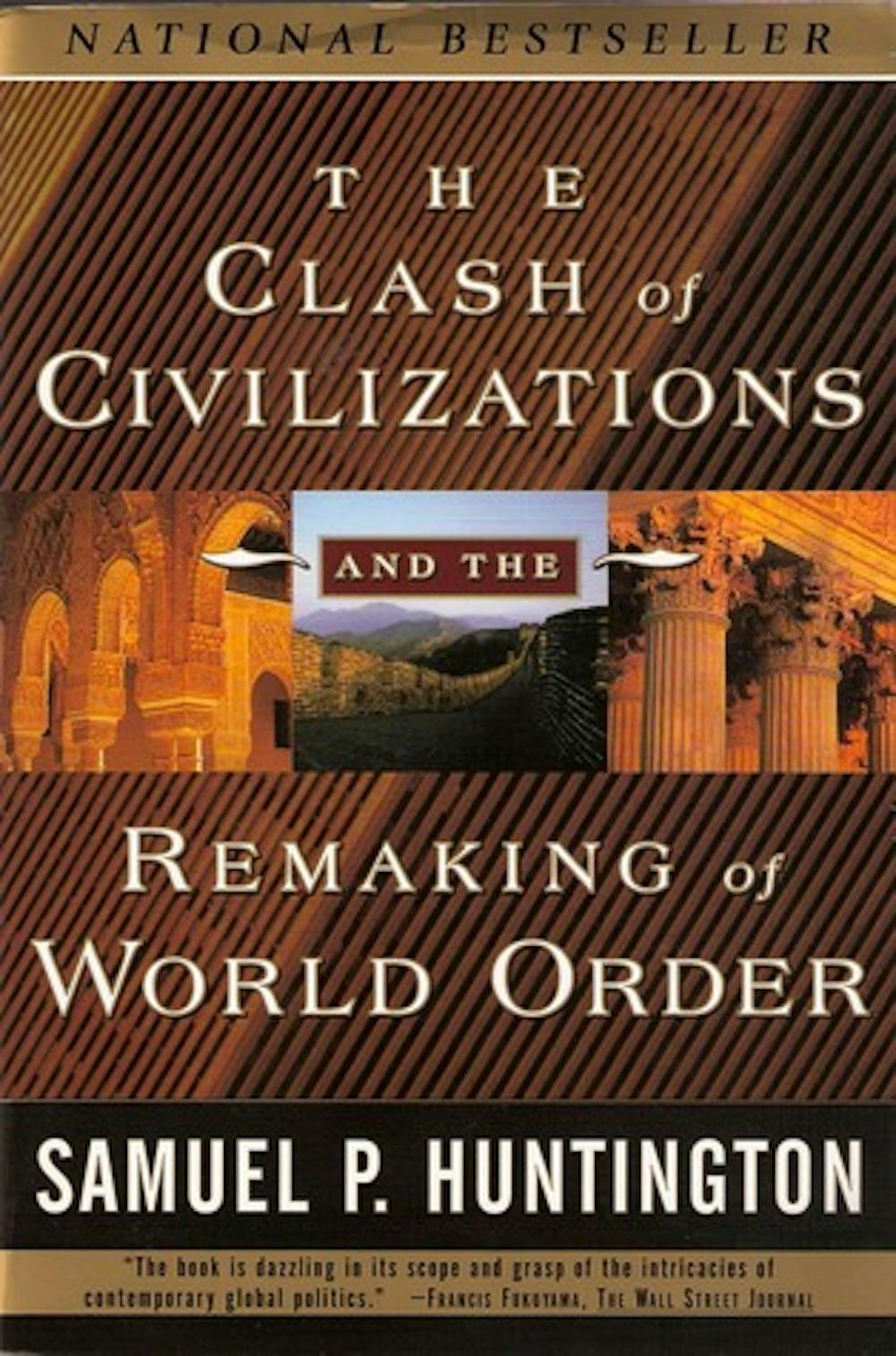
The cover of Huntington’s book.(GoodReads)
His piece, “The Clash of Civilizations?” — the question mark was removed for the book version — argued that wars had evolved from fights between princes to conflicts among nations and then to ideological clashes.
Huntington opined that the future conflicts that would dominate the
globe would be wars between civilizations. The most likely culprit would
be Islam which, he said, had “bloody borders.”
Sept. 11 elevated the theory
Without 9/11, Huntington’s theory would have likely been relegated to academia.
Even on the “Islam versus the West” count, it failed. It did not account for:
• A stable alliance between the United States and Saudi Arabia
• Sectarian or ethnic divisions within civilizations
(Protestant/Catholic; Sunni/Shia; Germany/France; Turks/Arabs/Persians/Malays, etc.)
The same applies to Huntington’s theory. Why does the theory still appeal, despite evidence that it’s wrong?
The Clash of Civilizations still has traction because of its emotive,
tribal appeal, setting up an us-versus-them scenario that’s helped
create anti-Muslim westerners and anti-westerner Muslims.
Harm to Muslim westerners
Muslim youth growing up in the West since 9/11 have experienced a “collective trauma,” as one of my students put it recently.
Their weekly reflection notes written in response to class
discussions roil with themes of despair at being scapegoated for violent
actions that happened before they were born and that they had nothing
to do with.
They’re resentful that their beloved faith has been singled out for
being violent, while they know and experience western violence in the
name of democracy. They watched as the U.S. dropped more than 26,000 bombs on Iraq, Syria, Afghanistan, Libya, Yemen, Somalia and Pakistan in 2016 alone.
Some feel anxiety and depression at not being able to fit in and be accepted for who they are.
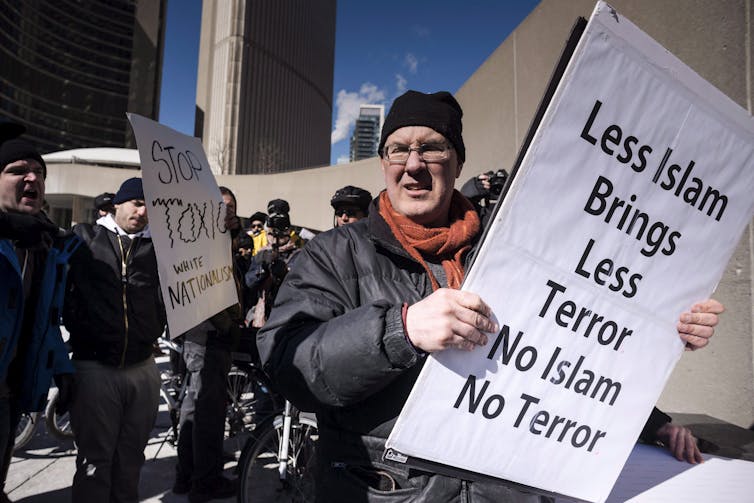
An anti-Islamic protester is pursued
by a group of protesters with opposing views during a demonstration in
Toronto in March 2017.THE CANADIAN PRESS/Christopher Katsarov
The scant literature
on the psychological fallout from being treated as a terror suspect
highlights mental health issues of despair, anxiety, depression — a
chronic trauma embracing the entire Muslim community, young to old.
The West and Islam share many values that can form the foundation of
good relations. There’s no need to outcast those who share ideals of
standing up for justice, service to the poor, aiding neighbours, being
kind to the elderly and children and the importance of hard work and
self-sufficiency.
Next year, the Clash of Civilizations theory will have done a
terrible job at explaining geopolitical forces for the past 30 years.
Let’s throw it a retirement party.


.JPG)